In less than three days I’ll start the Cruel Jewel 100 (CJ100). I’m pretty evenly split between excited and nervous. The answer to nerves is preparation. Thankfully, excitement serves as pretty good fuel for preparation as well.
There are a few different factors I’m working through in my preparation for CJ100: gear, pacing and timing, nutrition, and drop bags. In this post I’ll explain how I’m thinking about each.
Gear
I’ve run enough ultras to know what works for me over the course of a long race. I’ll wear Fabletics unlined The One 5″ shorts over generic Amazon compression shorts with storage pockets on each leg and a 32 Degrees Cool Classic t-shirt (inexpensive synthetic fabric t-shirt from Costco). For footwear, I’ll have my Creepers toe socks and Nike Zegama Trail 2 shoes.
For my pack I’ll carry my Ultraspire 5.0 hydration vest with a 2L bladder, one 500ml Hydraflask soft flask and a 650ml Raide soft flask – I feel the soft flasks ride more comfortably than the plastic bottles than came with the pack. I’ll also wear my Nathan Zipster Lite running belt to have a convenient place to stash additional gels and drink mixes and trash, as well as smaller items like Tylenol and chapstick in the zippered pockets.
I’ll carry my Leki Ultratrail FX One trekking poles and stash my Columbia Glennaker Lake packable rain jacket in the back of my pack in case we get a rain shower overnight while it’s cooler. I’ll carry my Black Diamond Cosmo 350 headlamp with multiple sets of batteries so I can run it at max brightness at all times – makes a huge difference for me in staying alert to have a really bright headlamp.
My wife bought me a Kea Peak ice bandana this week – an awesome surprise – and I’m excited to have it for this race. Finally, I’ll make healthy use of Squirrels Nut Butter to minimize skin damage. I’ll also carry a few baby wipes, just in case, and an emergency blanket.
Pacing and Timing
I’m a spreadsheet guy.
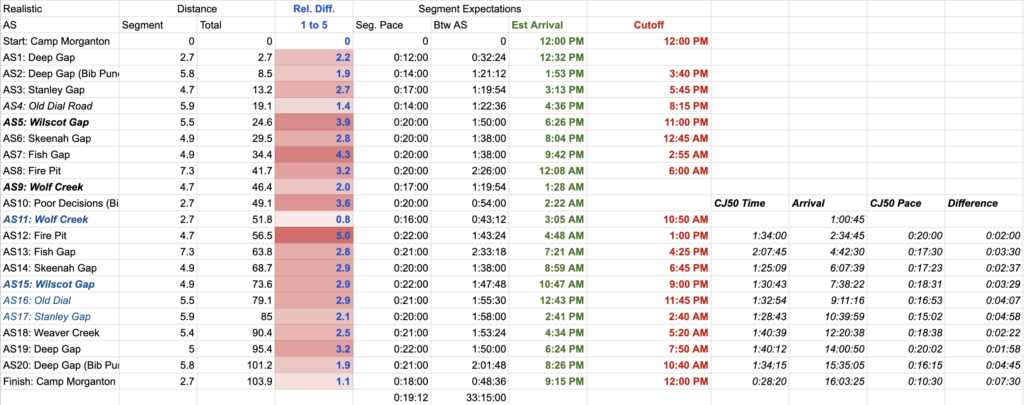
I have multiple scenarios mapped out. The screenshot above is what I consider a conservative but realistic estimate of how things might go. It predicts 33 hours and 15 minutes out on course for a 9:15 PM finish. I have also mapped out what a 30 hour and a 36 hour finish would look like. I’ve compared the back half of the race to my 2024 Cruel Jewel 50 time and created a custom “relative difficulty” score based on elevation change in each section.
I know this is a bit excessive, but it helps me think through things. With these various estimates in hand I have a general sense for how long it’ll take me between drop bags, the longest I’m likely to spend out on course between aid stations provided the wheels don’t come off, and I can plan my overall fueling and hydration strategy.
I won’t think about this spreadsheet once I start my race, but I will have some general checkpoints in mind. For example:
- Start: 12 PM
- Skeenah outbound: 7-9 PM
- Wolf creek outbound: 12-3 AM
- Wolf creek inbound headed to Coosa: 2-5 AM
- Skeenah inbound: 7-11 AM
- Stanley Gap inbound: 12-5 PM
- Finish: 6 PM-12 AM
I’ll write these time windows on my arm in Sharpie before the race so that as I get to each of these checkpoints I have a general sense for how close I’m pacing to a 30 or 36 hour finish based on where I am relative to these windows of time.
During the race I’ll run purely by feel. My goal during the early party of the race will be to feel effortless. This is the pace I maintained during my last couple of long runs and it’s the “all day ultra” pace.
There are a few key areas where I know I need to be extra cautious:
- The road section between Stanley Gap and Old Dial Rd: slight downhill on paved roads for ~5 miles. Risk of going too fast too early and then blowing up on the Benton Mackaye Trail. Stay super super relaxed.
- Climb between Skeenah and the Duncan Ridge Trail: Going up, there’s a major risk of pushing too hard and blowing up on the DRT. Coming down, there’s a major risk of blowing out my quads.
- Entire DRT, both ways: Will probably be mostly in the dark. Significant risk of falling. Relentless short climbs and descents. Must remain controlled but moving smoothly without stopping.
- Coosa, both the descent and the climb back up: 2-3 miles of continuous 10%+ grade. Risk of blowing out quads on the way down and generally blowing up on the climb back up. Stay controlled and easy both ways.
- Pointless out-and-back to Weaver Creek: If by some miracle I’m still running at this point, need to be careful not to blow out my quads on the way down or blow up on the way out.
The trick for mid-packers in ultrarunning is to move as efficiently as possible while maintaining the ability to run the flats and downhills for as long as possible. However, at some point during the race I will probably get to a point where I can’t run anymore. At GDR this happened after ~50 miles. At Georgia Jewel 100 this happened after ~70 miles. When it happens during CJ100 the plan is to really double-down on eating and hydration and hike steadily, and to try to run on the downhills and flats even if it’s at a 13-14 minute pace.
Nutrition
I’ve used Precision products for my last few races and plan to do the same here. My formula is pretty simple and has worked well for me in the past.
- PF90 gels, take half every 30 mins (90 grams of carbs per hour)
- PH1000 drink mixes, one per hour (17 grams of carbs, 500 mg of sodium)
- Additional water to thirst
That’s how I’ll start. I’ll toss in a caffeinated PF30 gel every ~4 hours until it gets dark. Once it gets dark I’ll alternate between PF90’s and PF30’s – worth noting I drink a lot of coffee so my caffeine tolerance is extremely high.
I’ll slow down on the carb intake if my stomach tells me I need to (bloated, sloshy feeling, stomach pain). First I’ll try backing down to 1/3 of the PF90 and if I still feel bloated I’ll skip an interval and then come back with 1/3 of the PF90. I expect that during the night I’ll need to throttle back to 1/3 of a PF90 every 30 mins (60 grams per hour).
I also have a second electrolyte drink mix that is stronger than the PH1000 packs (1000 mg sodium vs 500 from the PH1000 pack). If I feel like I’m running behind on electrolytes (cramping, bonking despite fueling sufficiently) I’ll supplement with that separate mix.
At each aid station I’ll also have a little coke and try to grab one real food item. I’ll skip my next 30 min fueling interval after the aid station to account for this.
I feel pretty dialed on nutrition and hydration. This has been my approach for long runs and how I’ve approached nutrition in my last few ultras with solid success. The real key is keeping up with the fueling in the second half of the race when I no longer want to take anything in.
It’s worth noting that my approach is pretty solidly high-carb. In the early part of the race I plan to take in 100+ grams of carbs per hour. That will slow down as the race goes along, but even in the back half of the race as long as my stomach lets me I’ll be taking in 60+ grams of carbs per hour. My body responds well to this approach. I’ve done it in several long races in the past and it’s how I’ve fueled my longest training runs.
Drop Bags
I’ll have drop bags at two locations:
- Wilscot Gap aid station: miles 25 and 74
- Wolf Creek aid station: miles 46 and 52
My spreadsheet also includes calculations to estimate how many gels and drink mixes I’ll need. Based on those estimates and my estimated times to arrive at each aid station, my drop bags will include:
- Wilscot: 12 x PF90’s, 8 x PF30’s, 20 x PH1000’s
- Wolf Creek: 6 x PF90’s, 4 x PF30’s, 8 x PH1000’s
To keep things super simple, I’ll start the race with 6 x PF90’s, 4 x PF30’s, and 8 x PH1000’s, and make sure I leave the Wilscot and Wolf Creek aid stations with my supplied replenished to these same levels.
A couple of additional odds and ends I’ll stash in my drop bags:
- Baby wipes, KT tape, and fresh socks in each bag so I can do a hard reset on my feet if needed.
- A second pair of Zegama’s that are a half size larger in the Wilscot drop bag just in case my feet are feeling super wrecked at mile 75 and larger shoes feel like the way to go.
- I’ll have a fresh set of batteries and an inexpensive backup headlamp in each drop back just to be safe.
- Squirrels nut butter, to be used without exception, in each drop bag.
Preparation is Peace of Mind
I’m getting to the point where I feel like a veteran. I’ve done enough of these and thought through the logistics enough that I feel confident in my plan. However, when you’ve been running for 20+ hours and are sleep deprived your brain stops working particularly well, and in that moment you have to fall back on the rules you set before you started the race. In my case, those rules include:
- Fuel and hydrate every 30 minutes
- Drink and eat at every aid station
- Lube at every drop bag
- Keep moving, avoid the chair unless it’s to change shoes or socks
Follow those rules and as long as the wheels don’t come off (which is always a possibility) I’ll get to the finish line.