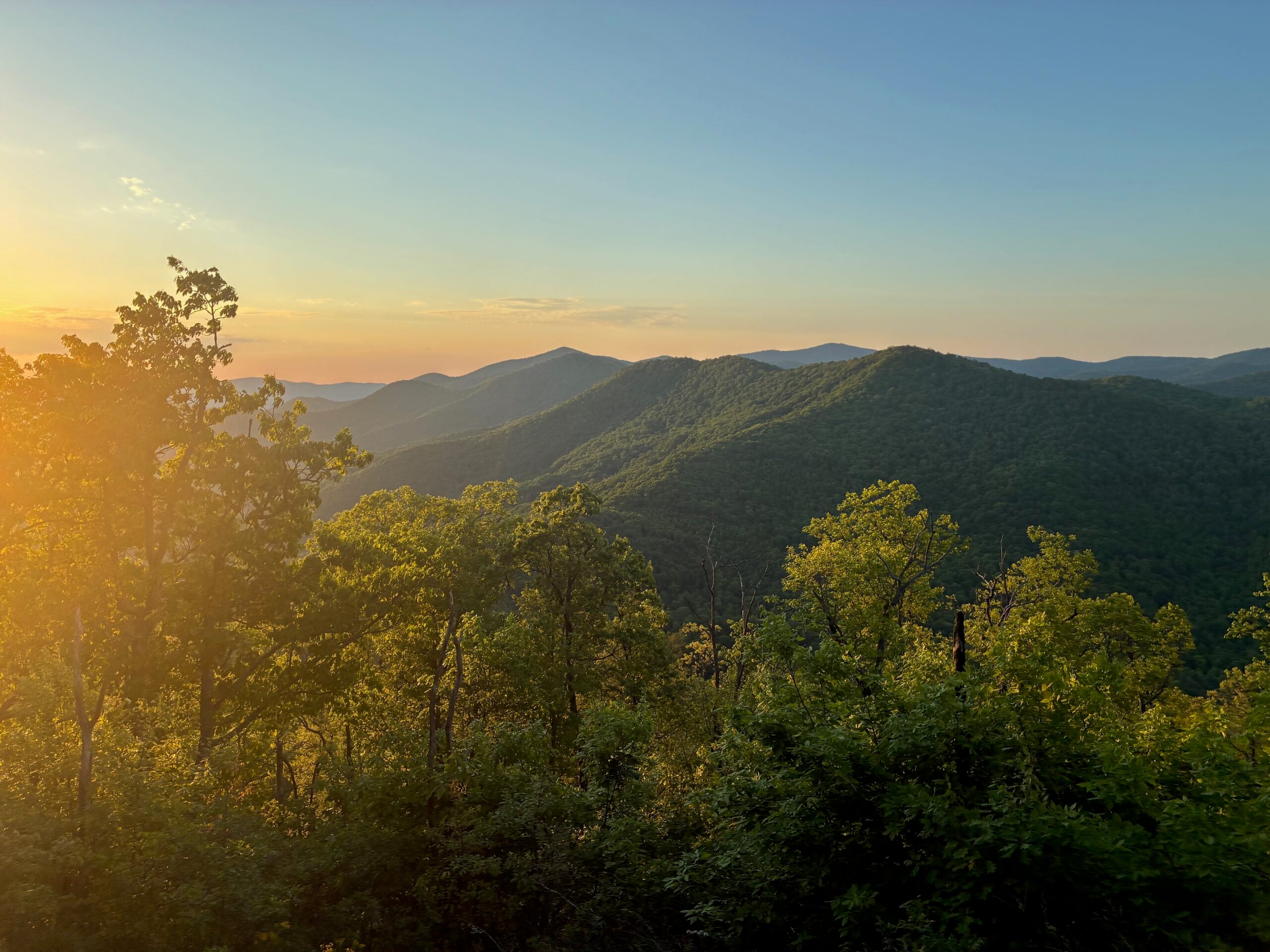
At noon on Friday, May 15, 2026, I started the Cruel Jewel 100 in Blue Ridge, GA. The race is ~108 miles long and includes ~30,000 feet of climbing and descending along a variety of rugged mountain trail systems include the Benton MacKaye and Duncan Ridge trails. My race on the other hand ended after 83 miles as I took the first DNF (“Did Not Finish”) of my ultra career.
I’ve already shared a lot about my training and strategy going into this race, so I won’t spend any time on background. Instead, in this post I’ll share my experience running the Cruel Jewel 100, focusing on the course and logistics, including why I ultimately decided to pull the plug about 25 miles from the finish line and the lessons learned along the way.
Flat Creek Loop & Stanley Gap Trail
My son drove me to the start line on Friday morning and at noon away we went. The first ~2.7 miles of the race are on the roads until you reach the Flat Creek loop trailhead. The first mile or so is downhill and I ran it very controlled. From there you head uphill basically until the start of the Flat Creek loop. I hiked and jogged up the hill keeping an eye on my heart rate. At this point I felt ok, not great.
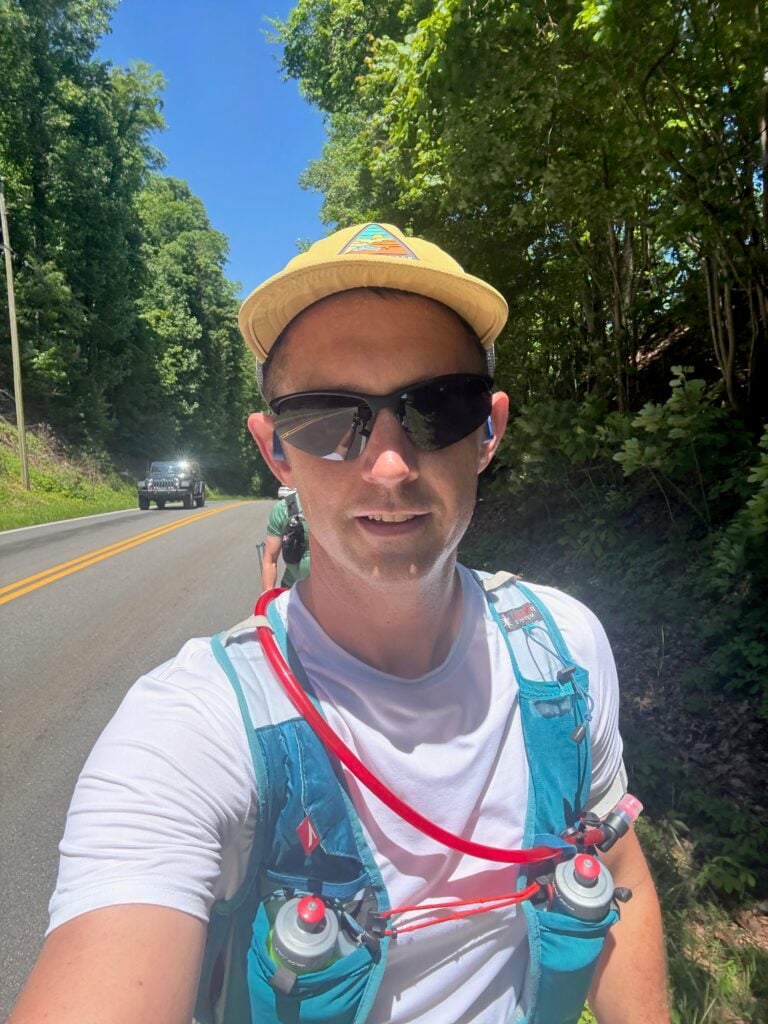
The Flat Creek loop starts with a long gradual uphill. It’s runnable, but I kept things controlled and hiked all but the gentlest of climbs. Eventually things shifted to a long descent and the trail grew more narrow and technical. I tried to flow smoothly and ended up running with a large group for a couple of miles, eventually passing the group and running on my own for the last mile or two of the loop as I made my way back to the Deep Gap aid station.
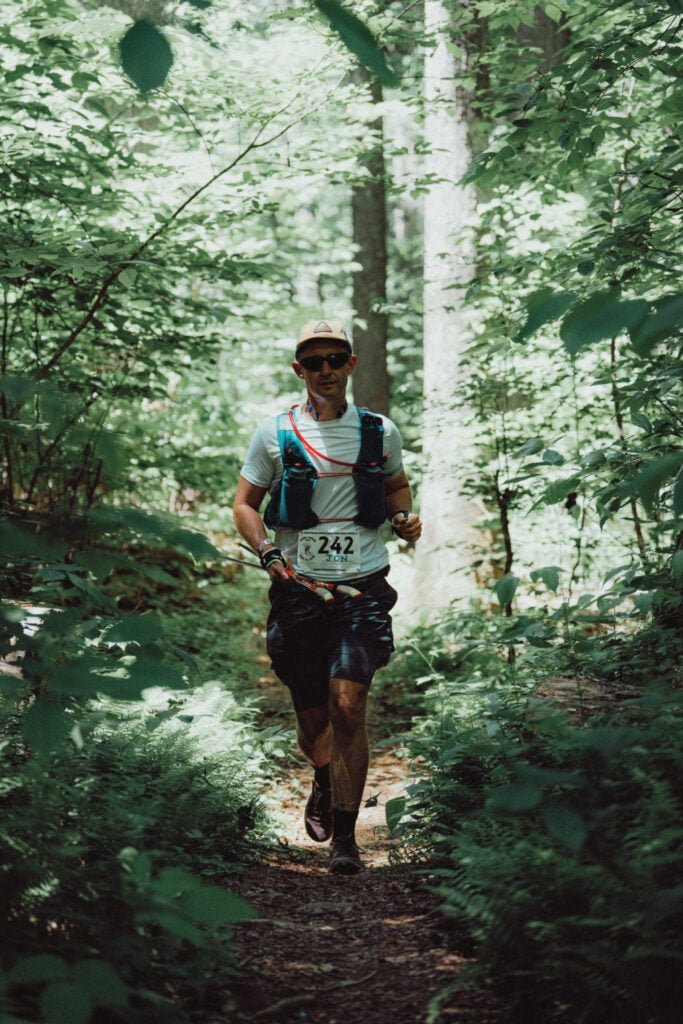
Leaving Deep Gap the course follows the Stanley Gap trail which is somewhat technical, but well trafficked. As a result the trail isn’t particularly narrow and the climb is very manageable. The section of the Stanley Gap trail between the Deep Gap and Stanley Gap aid stations basically consists of a long manageable climb followed by a long manageable descent. The race starts with the most runnable trails you’ll encounter during the entire race.
Stanley Gap to Old Dial Aid Stations: the Road Section
The Stanley Gap trail ends at the Stanley Gap Aid Station. Leaving the Stanley Gap Aid Station the course follows a gravel road for a mile or two, which ends on an asphalt road. The course follows gentle gravel and asphalt roads for about 5 miles in total at this point and moving in this direction this entire section is largely downhill.
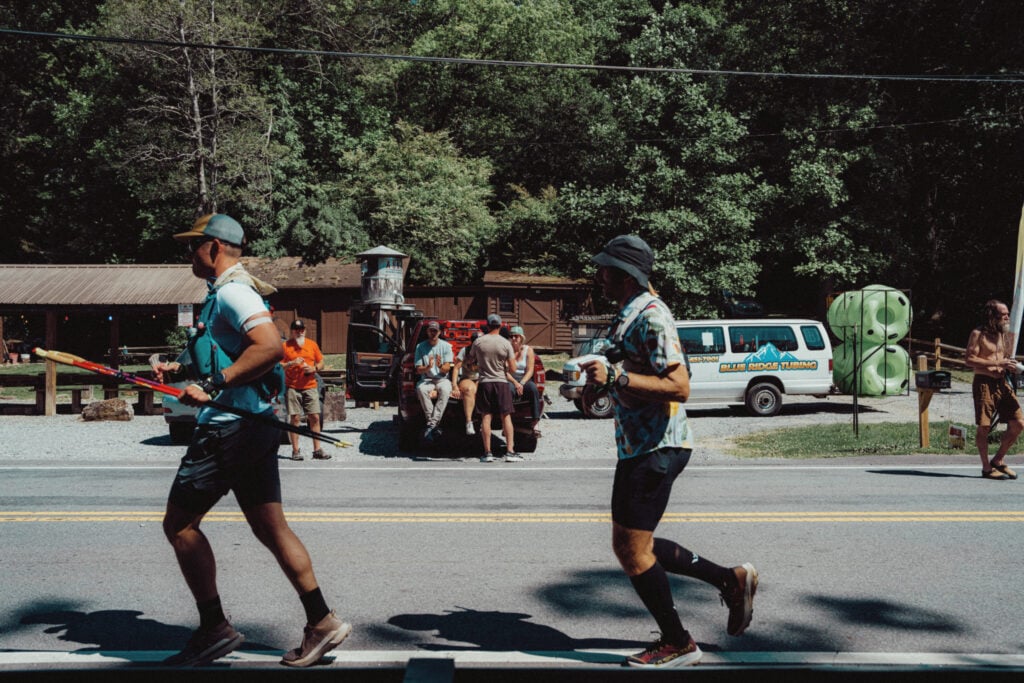
I tried to run this section comfortably but I wasn’t having the best day. My heart rate was higher than usual and even running “easy” felt labored.
The last mile or so of this section jump onto the Benton MacKaye trail and in the last mile there’s a moderate climb followed by a moderate descent into the Old Dial aid station. Arriving at the Old Dial aid station at around mile 20 signals the end of the warm-up. Things are about to get a lot more interesting.
Old Dial Road to Skeenah Gap: The Benton MacKaye Trail
The Duncan Ridge trail gets all the press, but as someone who has run both the BMT and DRT several times let me tell you: you overlook the BMT at your peril. While the DRT might be harder than the BMT in some ways, the BMT is a serious trail. There are long steep climbs, long steep descents, and sections where the trail is overgrown and badly cambered. My personal ranking suggests the BMT is about 80-90% as challenging as the DRT.
The BMT section is split in two by the Wilscot aid station, a welcome break from the endless climbing and descending. There’s not much to comment on here: the trail is either going up or going down and is often very steep. There are sections that are badly overgrown, or muddy, or rocky and rooty, or badly cambered, or all of the above. There are also some lovely runnable sections like the one pictured below.
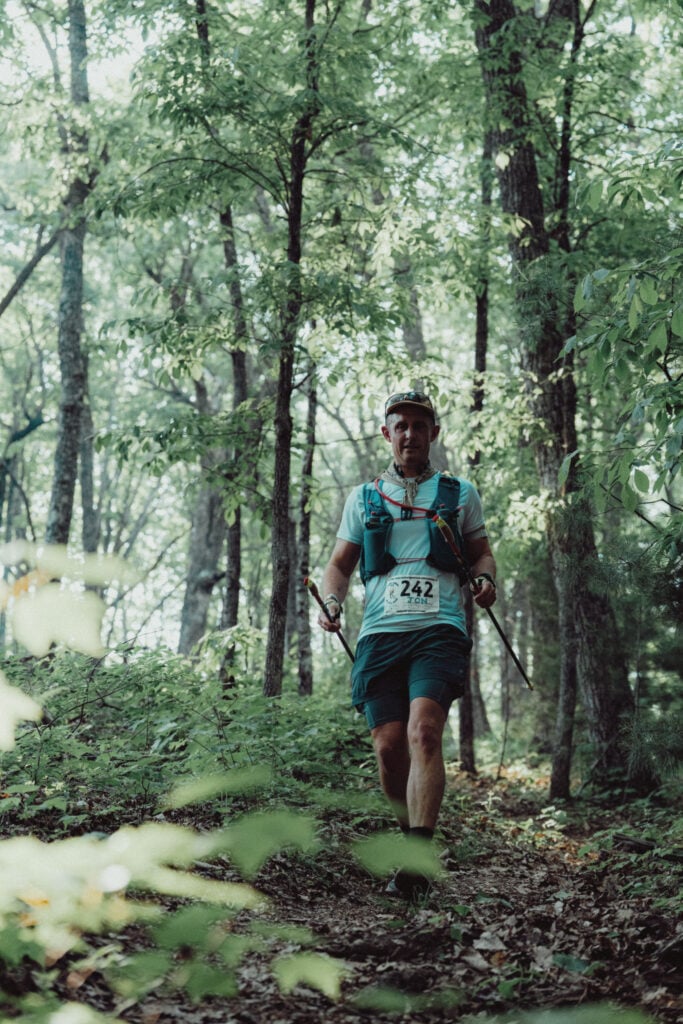
I run these types of trails well. I train in northeast Georgia all the time, so I’m very comfortable on trails like the BMT and DRT. They’re a little more serious than my home trails, but not much. So I flowed smoothly and comfortable from Old Dial to Wilscot to Skeenah. During this section I started to feel pretty good. My body likes the constant transition between hiking the climbs, jogging the flats, and shuffling the downhills. I felt strong and fluid running the BMT and arrived at the Skeenah Gap aid station feeling pretty good.
The Duncan Ridge Trail
Leaving Skeenah the course climbs up the BMT until it reaches the DRT at which point the trail continue to climb for several more minutes. By Georgia standard, this is a pretty serious climb – nearly 1,000 feet of climbing in about a mile and a half. By the time you finish climbing, you’re on the DRT. The next 4 miles though are some of the most runnable of the entire race. While the DRT is known for the dragon spine, this section prior to the dragon spine is flowy and mostly smooth and clear. I ran this section really really well. This was the best I felt all race. I felt strong but relaxed and ran really well.
There are two aid stations along the DRT: Fish Gap and Fire Pit. I’ve already talked about the section between Skeenah and Fish Gap. Aside from the climb up to the DRT from Skeenah, that section is pretty nice. However, the section between Fish Gap and Fire Pit is a different thing altogether. This is the legendary dragon spine and it’s the longest stretch between aid stations of the entire race.
It’s hard to express how challenging this section of trail is. Is it the relentless repeating steep climbs and descents? The fact that the trail is badly overgrown for miles? Is it the off camber slope that pitches one way and then the other? How about the technical sections where plate-sized boulders peak out between tufts of knee-high grass? Or is it the fact that you complete this section in the dark, twice? Or maybe it’s just that it’s 8 miles of slow-going when you already have 35 miles on your feet? In truth, it’s all of that and more.
Despite how incredibly challenging this section of trail is, I ran it pretty well. I felt strong and controlled. I fueled and hydrated well and arrived at Fire Pit feeling like I was under control.
Coosa to Wolf Creek
Leaving Fire Pit, you’re perhaps a mile from the summit of Coosa. Unfortunately, you’re also about 800 feet below the summit. The climb from Fire Pit to the Coosa summit is steep and the footing is loose with rocks, dirt, mud, sticks, and leaves constantly shifting beneath nearly every step. After a hard mile of climbing you summit Coosa and begin the descent.
For the most part, the descent from Coosa to Wolf Creek is pretty manageable. It’s steep, but not exceedingly steep. It’s technical, but not so technical as to be unrunnable. It’s just shy of 4 miles long and drops over 2,000 feet. It’s downhill nearly the whole way with a few brief sections where the grade reverses direction in the last mile or so.
Coosa is where my race began to come apart. I had felt labored on the climbs all day, but the climb from Fire Pit to the Coosa summit is the first time I felt weak – not a good feeling when you know you have 60 miles to go. During the descent off Coosa I tried to run smooth and relaxed – not fast, but also not braking to avoid overloading my quads. However, coming down Coosa is where I started to feel my quads talking.
The Poor Decisions Out-and-Back
Perhaps the easiest part of the race. From Wolf Creek, the trail to Poor Decisions is nearly entirely uphill, but the grade is gentle. It’s too steep to run for most runners at that point in the race, but it’s not so steep as to be a challenge to hike. In return, on the way back it’s nearly entirely downhill but at a very manageable grade that nearly everyone will run comfortably.
I felt great on this out and back. I had started to get worried going up and over Coosa, but this felt like just the recovery window I needed. I hiked comfortable to the Poor Decisions bib punch, turned around and flowed back down to Wolf Creek.
At Wolf Creek for the second time I did a full reset using my drop bag supplies. I had some hot spots working on both feet so I took my shoes off, redid my KT tape on both feet, and put my shoes back on. While I wasn’t having any chaffing issues, I reapplied lube to all the important places. I took about 10 minutes and made sure I was as prepared as possible to start my journey back towards Blue Ridge.
Back Over Coosa
The return trip up Coosa quickly revealed that I wasn’t in a good place. The first mile or so is pretty gentle, but even so as the climbing resumed I could tell my climbing power was rapidly dwindling. I continued to move steadily but it quickly became to clear to me that whatever strength I had left to climb powerfully wouldn’t last long. I summited Coosa moving well enough, but knew I was running on fumes. As I descended Coosa to Fire Pit my quads lit up and let me know that it wasn’t just my climbing legs that were nearly done, my downhill running legs were also about to call it quits.
The DRT: Fire Pit to Fish Gap to Skeenah
The return trip from Fire Pit to Fish Gap was as bad as the first round several hours earlier. I did my best to really manage my effort on this section and was somewhat successful in avoiding a complete blowup. The sun rose as I moved through this section and that provided an emotional lift I needed badly.
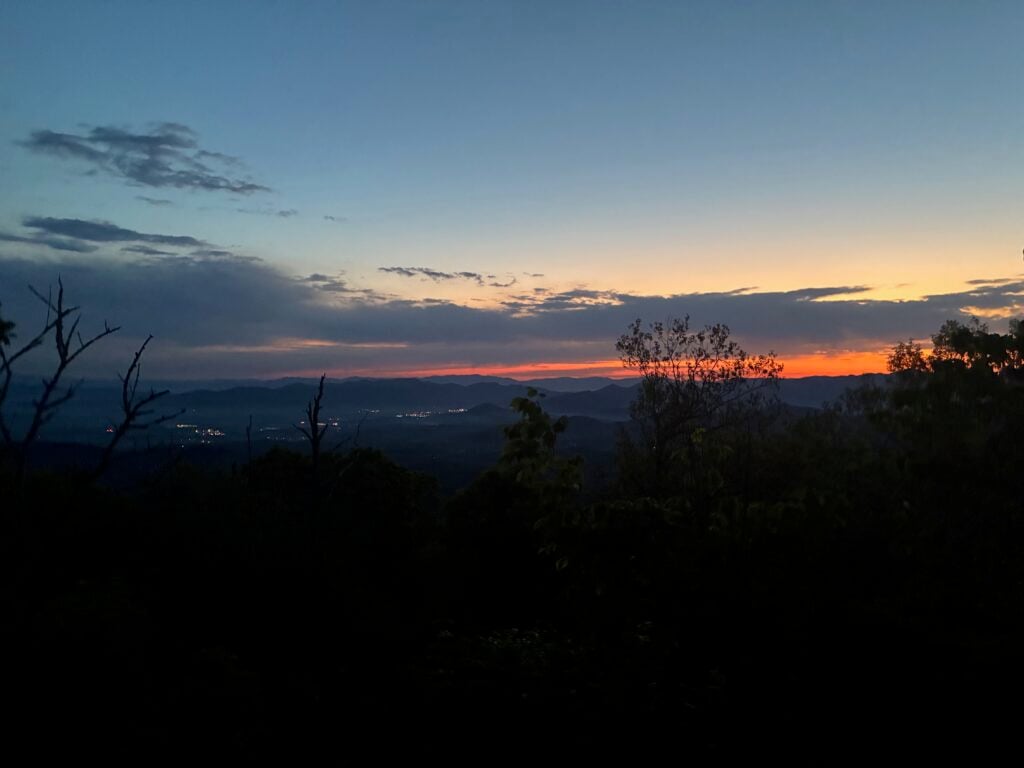
Arriving at Fish Gap, I knew I had several miles of relatively runnable grades. However, I also knew I was teetering on the edge of completely losing my ability to run. I did my best to move smoothly, running where I could without slipping over the edge.
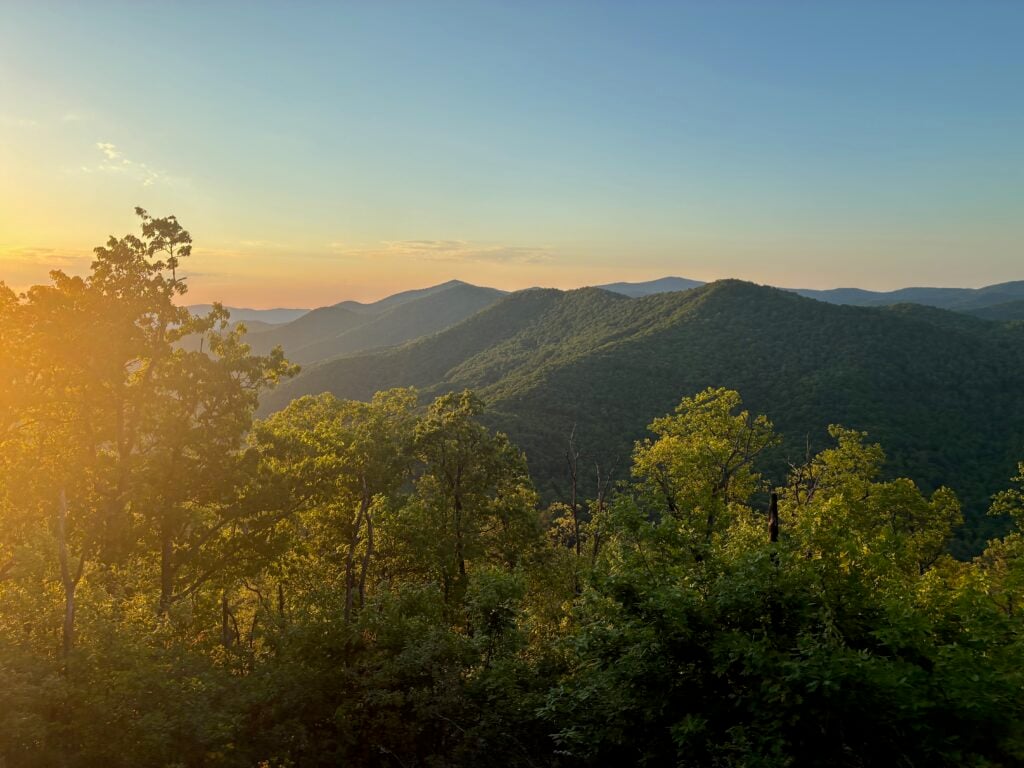
Near the end of this section, just before the descent into Skeenah, is one of the worst climbs of the entire race. This short climb is about a half mile long and climbs about 400 feet, but it’s the last tenth of a mile or so that is truly devious. It’s slippery grass and dirt underfoot and steep enough you’ll find yourself reaching for branches, exposed roots, and small trees along the way steady yourself.
After this climb you have a long descent into Skeenah. The first part of the descent isn’t bad at all. The grades are gentle and while the trail is obnoxiously cambered, it’s relatively clear and smooth. However, the last half mile or so gets pretty steep and just basically runs straight down the mountain.
It was on this run down into Skeenah that I realized my running was basically done for the day. While I was able to shuffle down the mountain, my quads were gone and I knew once I stopped running I probably wouldn’t be able to start running again.
Skeenah to Wilscot to Old Dial: Contemplating DNF
I left Skeenah pretty quickly after refilling everything and eating a little and kept moving. However, from the moment I left Skeenah I could tell I was entering death march territory. The DRT had taken it’s toll. My quads were shot, my climbing legs were gone, and my feet were blistered. While I was fueling and hydrating well, and my stomach was fine, my running legs were gone. The rest of the day was going to be a slow slog and the only question was: how long was I willing to slog it out?
Between Skeenah and Wilscot I started to really feel the fatigue. By the time I reached Wilscot I’d been on the course for a little over 24 hours, meaning I’d been awake for over 30, and I was starting to fall asleep on my feet and stumble around on the trail quite a bit.
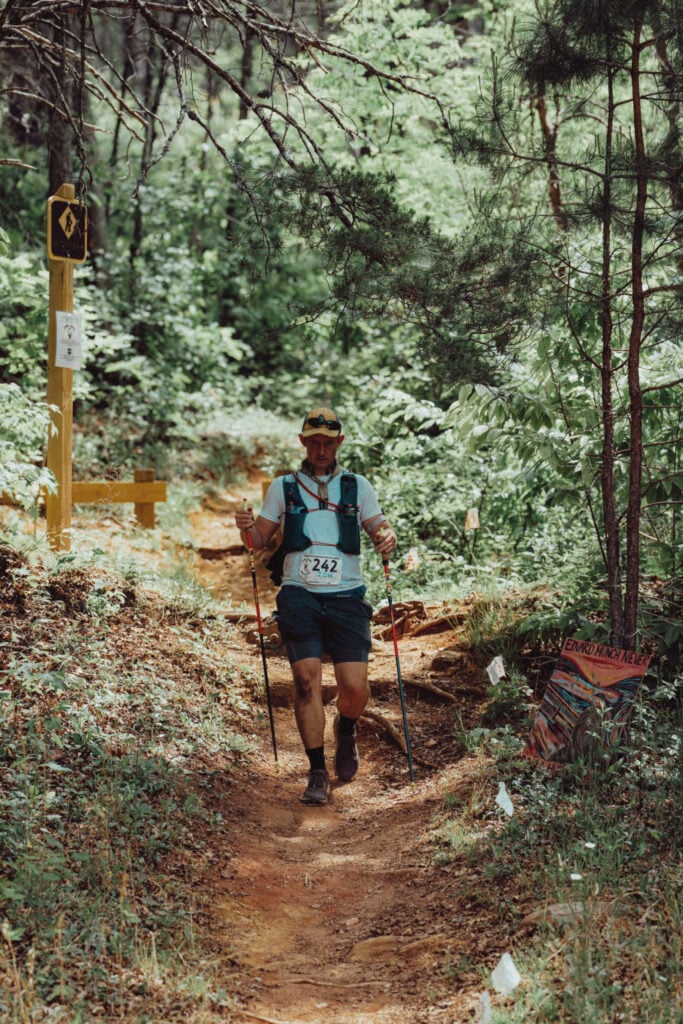
I started to think seriously about dropping as I approached Wilscot. I was frustrated that I’d lost my ability to run, I didn’t really have any interest in death marching for hours and hours on end. And I felt like I was moving incredibly slowly. When I arrived at Wilscot I told the aid station volunteers that I was really not in a good place and they immediately set to work trying to help me get put back together.
With the help of some aid station volunteers, I made an attempt at salvaging my race at Wilscot. I sat down and ate a sandwich, had two small cups of coffee, and then leaned my head back and slept for 10 minutes. After that I raided my drop bag to restock my hydration vest and headed back out on the trail to see if the hard reset would get me moving. For the first mile, it seemed to really help. Whether I was moving faster or not, my spirits were higher. However, after about a mile I was back where I started: struggling badly up the climbs and unable to run at all on the downhills. I was hiking the flats well, but there just isn’t that much flat on the BMT.
By the time I made it to Old Dial Road aid station I’d made up my mind that I was done. When I reached Old Dial Road I immediately to the aid station volunteers that I was done, handed in my bib, and texted my family to come pick me up.
What Went Wrong (i.e., Why Did I DNF)
I’ve had a few days to reflect on what went wrong during CJ100 and come away with several takeaways.
Takeaway #1: For hundred milers, I need my training volume to peak at 70+ miles per week rather than ~40-50 miles per week, and I need multiple long runs that exceed 30 miles.
I was undertrained. My goal when I run races is to run strong to the finish. If this race had been 70 miles long I would have accomplished that goal. Unfortunately, my legs only made it 2/3 of the race before giving out. I don’t find it nearly as fulfilling to struggle to the finish line. I respect that others find that super fulfilling, and I find it inspiring, but that isn’t my goal. My goal is to train so that I can be strong to the finish, not just survive to the finish.
Takeaway #2: When embarking on races that are harder and longer than what I’m used to, completion needs to be my primary goal and I need to pace accordingly.
Even though I tried to run controlled, I was going too fast for the first 60 miles relative to my training volume and fitness. I’ve got to keep the ego in check and slow down, especially when I’m doing a race that’s above my historical experience level.
Takeaway #3: I need to leave auto-laps on during ultra events so that I have a more accurate sense of how I’m moving and can make more informed decisions.
Before the race I turned off auto-lap notifications on my watch. My thinking was that I didn’t want to subconsciously push too hard hoping to see faster times on my watch. However, what actually happened is that as the race wore on I had no way to know how fast or slow I was going, and it turned out I was going faster than I thought.
Towards the end of the race, just based on how I felt, I thought I was averaging ~30 minutes per mile. But looking at the data, my last 5 miles averaged about 23:45. Not fast by any measure, but way faster than I felt I was moving. If I’d realized I was still moving that well I might have kept going.
Takeaway #4: Don’t start a race if I have external time pressures that limit my ability to fully commit.
My son was scheduled to fly out of Atlanta on Sunday afternoon. While I had made arrangements to ensure he could get to the airport without me if needed, I still felt a very strong desire to get done in time to see him off. I’m his Dad and I wanted to make sure he got to the airport with everything he needed and got on that plane. To do that, I needed to finish and get home and be reasonably functional on Sunday. Based on this factor alone I shouldn’t have started this race. I left myself with only two options: knock it out of the park on my first try or DNF. While there were still nearly 22 hours left in the race when I DNF’d, I couldn’t afford to be out there that long. I needed to get done and get home.
Takeaway #5: Keep looking for shoes that work beyond 50 miles.
My shoes didn’t work. They were fine for the first 50 miles, but over the next 33 miles my feet fell apart. I finished the race with large blisters on both heels, and a blister nearly as large as the base of a coffee mug on the instep of my right foot. In addition, I had pretty severe pain at the ball under my pinkie toe on both feet as well as numbness on the outside edge and pinkie toe area of both feet after the race. I don’t know what was going on there, but something about the shoes was really harming the outside edge / pinkie toe area on both feet.
What Went Right
So that’s a long list of learnings and takeaways. But what went right? There were several things actually.
First, I had zero chafing issues. I used Squirrel’s Nut Butter plus some no-name-brand compression shorts, completely cleaned up and generously re-lubed at Wolf Creek, and had zero issues. I don’t think I’ve ever finished any ultra with zero chafing issues.
Second, I consumed an incredible amount of calories and drank gallons of fluid and electrolytes without issue. My stomach is my greatest ultra strength. I had an incredible number of Precision gels and electrolyte drink mixes, many of my drink mixes were mixed into Tailwind from the aid stations. I also drank coffee and coke, the latter at nearly every aid station. I ate watermelon, quesadilla, grilled cheese, pickles, orange sections, candy, and more. I had no stomach issues all day. I estimate that averaged 80+ grams of carbs and 750+ mg of sodium (plus other electrolytes) per hour for the 26 hours I was on course.
Third, aside from my shoes, I had no gear issues. Everything else did it’s job perfectly: Leki poles, Ultraspire pack, bladder and bottles, shorts, Nathan flip belt, sunglasses, hat. My gear was dialed.
Will I Try It Again?
It’s been five days. Will I try CJ100 again? Maybe. I won’t do it again under the same conditions: undertrained and feeling time pressure. If I do CJ100 again I will only register after I’ve proven to myself I can reach and sustain training weeks at 60+ miles per week. And I’ll only start the race if I feel the freedom to use all 48 hours if it comes to it.