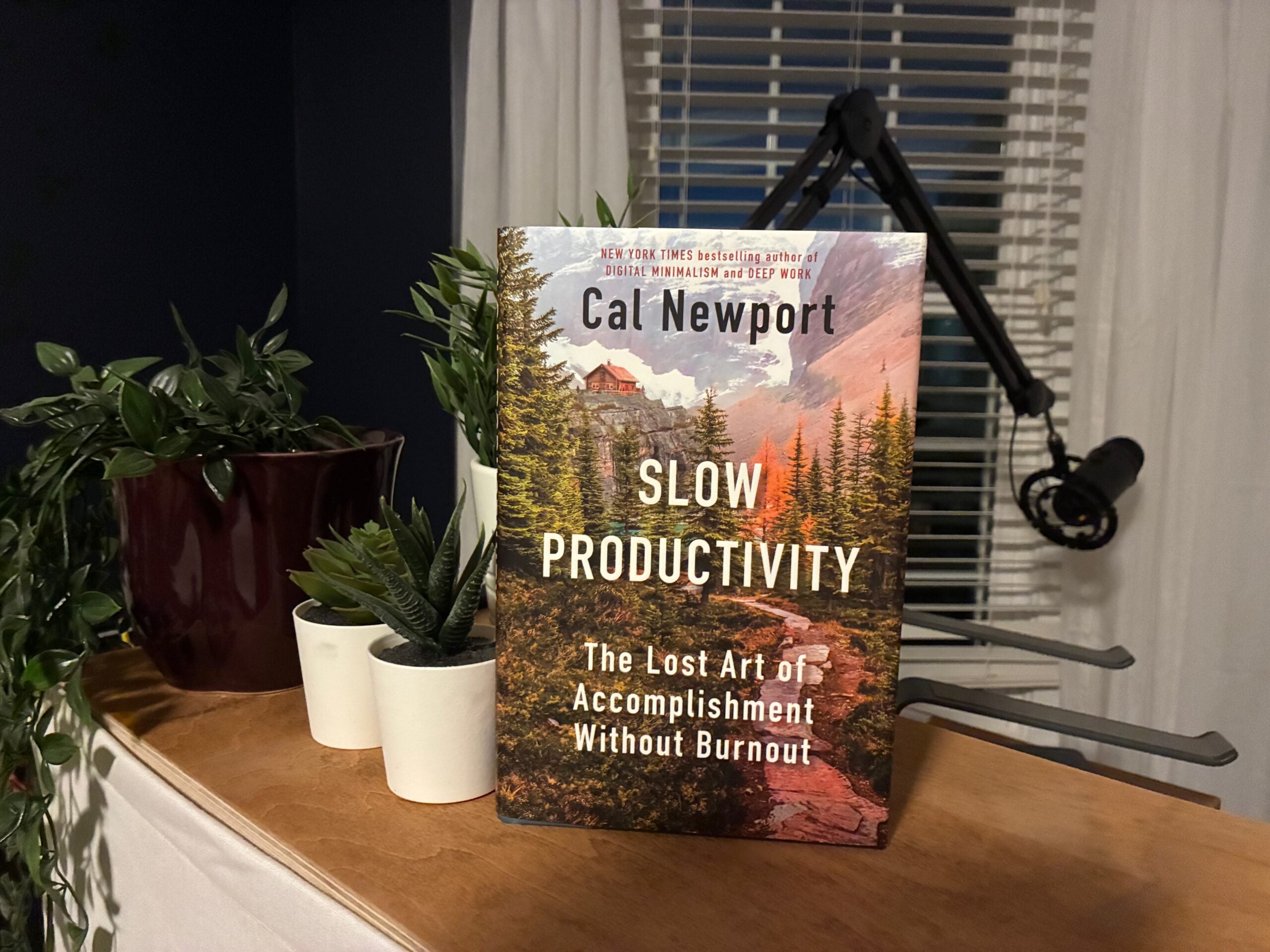
Do fewer things. Work at a natural pace. Obsess over quality.
These are the core principles presented in Slow Productivity by Cal Newport. According to Newport, by doing these three things you can accomplish more when viewed from a long-term perspective.
If this sounds simple, that’s because it is. Slow Productivity is not a complex book, to the point that one could argue that it could have been a blog post – a point I’ve seen made in some reviews of the book. The book is built around these three core principles and then spends a lot of time providing examples of highly productive people who demonstrate the principles in action and suggesting methods of implementing the principles in your own work life.
It’s also worth noting that the core ideas of this book will not be new to anyone who has followed Newport’s prior work. While the packaging is a little different, similar concepts are presented in Deep Work, So Good They Can’t Ignore You, Digital Minimalism, and A World Without Email.
The benefits of ruminating
My own sense is that Slow Productivity is a distillation of the core productivity principles Newport has presented over the last several years in his books and on his podcast. I found it to be more conceptual and a little less prescriptive than some of his prior books. It’s as if he backed up a few steps from his prior work to say “let me give you the big picture.”
There are different ways of looking at a book like Slow Productivity. One way to look at it would be to say that it’s pretty light on substance. In my opinion, that argument has some merit. It is a light read. However, I still enjoyed the book and would recommend it to anyone who finds the premise compelling.
Why would I recommend a book felt thin on substance? Because I think there’s value in spending time ruminating these ideas. In a world that increasingly devalues boredom and rumination, this book provides space for your brain to build associations between the ideas presented and your own work life.
Are you going to learn a ton of new ideas reading this book? Probably not. Especially if you’ve followed Newport’s prior work. But the handling gives your brain space to ruminate, and that’s a good thing.
Ideas I took away from the book
My claim is that the book enables rumination. If that’s the case, what sort of observations did this rumination inspire in me?
Obsessing over quality
One of the things I do is develop and communicate goals for our company. I write out specific quarterly goals as well as long-term directional guidance our teams can use as they do their own goal setting. In my opinion, this is some of the most important work I do.
As I was doing this work over the past couple of weeks I initially used an LLM to draft the longer-term guidance document (something I call “The Long View”). While this proved a useful brainstorming exercise I ultimately opted to rewrite the entire document from scratch after a couple days of working and reworking the ideas I wanted to communicate. In the end, I produced a document I believe in and one where I can explain and defend every sentence.
Was it slow? Yes, somewhat. The entire process took most of a week, but the quality is very high. And I believe the impact will be immeasurably higher than it would be otherwise. Because I believe in the end-product, the way I present it will be markedly different than if I’d settled for simply cleaning up the LLM-generated draft I started with.
Doing fewer things
While in a prior role, administration used to be my primary responsibility and during that time I was added as an admin user to dozens of systems we use at work. Beginning a few years ago that changed. However, in the interest of business continuity, I allowed myself to remain an administrator for many systems that were no longer needed for my new role.
More recently I’ve come to recognize that the residual cognitive load and additional noise in my inbox from remaining an admin for these systems is reducing my ability to do my most important deep work (such as the goal setting work in the prior paragraph). The decision I made a few months ago was to begin watching for opportunities to remove myself from these systems and lingering responsibilities. When a question arises or a system comes up for renewal, I’m working with operations to identify a new owner and handing these systems over. I’m doing fewer things and freeing up time and brainpower for my most important work.
Your mileage may vary
This morning I was listening to a rebroadcast of the Ezra Klein Show on Hard Fork. In the episode, either Klein or his guest suggested that the leading experts at AI labs have primarily worked in highly specialized and technical individual contributor roles and don’t genuinely understand how multi-faceted and ambiguous most white collar roles are. The implication being that AI experts may tend to overestimate how many roles LLMs will be able to eliminate because they don’t understand how much of what white collar workers do is not easy to put into a workflow with defined steps. Because their own roles have been highly specialized and focused with a defined deliverable, they mistakenly assume most white collar roles are like this.
I had a similar thought reading Slow Productivity. I like the ideas Newport presents, and to some degree I’m able to apply the ideas to my own work. However, the ideas presented will be most applicable to roles which have a clearly defined core deliverable: authors who need to produce books or articles, college professors who similarly need to produce scholarly content, creatives of all types who need to produce original material. The ideas are useful and thought-provoking, but they seem to stem from someone who has spent most of their professional life with big meaty deliverables that are the primary product of their work.
As I think about the roles where I work, there are many roles where the ideas have extremely limited applicability – and every single role where I work is white collar by definition since we’re a completely distributed company where every person is working from a laptop. The ideas are still worth ruminating, but applicability will vary quite a bit from one reader to the next based on the specifics of their responsibilities.
In fewer words
In Slow Productivity Newport posits that you will be more productive over the long term if you do fewer things, work at a natural pace, and obsess over quality. The suggestions Newport makes will be most applicable to knowledge workers who have clearly defined deliverables as a core part of their responsibilities. The book covers much of the same territory as Newport’s prior work, so those familiar with his work may not find much here that is completely new. There is also not a tremendous amount of depth but this has the benefit of leaving the reader with room to ruminate and consider how the concepts apply to their own context.